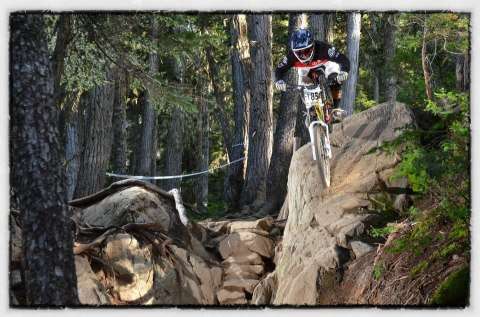
BetterRide Head Coach Andy Winohradsky discusses protective gear for mountain biking: Summertime is in full swing and that means its downhilling season! Even if you’re a not full DH racer, there’s a pretty good chance that you’ve at least entertained the idea of going to a resort; renting, borrowing (or buying…he he), a DH bike, and having a day of chairlift accessed good times. If not, I highly encourage you to do so. However, there can be a little trepidation with the whole downhilling thing, and rightly so. Downhilling can be dangerous (just like regular trail riding), but there are a few things we can do to minimize those dangers. First and foremost: wear protective gear. Lately, I’ve gotten a few questions from riders fairly new to the downhilling game about what gear to wear, how much, “do I really need a full-face helmet …”, etc. So I’ll try to shed some light on the whole body armor thing, but let me first say that all this gear is made for a reason, and WHEN you crash, you’ll be glad you had it on (or wish you did!). … And, yes, you do NEEEED a full-face helmet! Here’s my gear list when I get on a DH bike So there you have it. I’ve been DH’ing for a long time and I really wouldn’t feel comfortable riding with any less gear then the stuff I listed above. Have fun, be safe! Of course learning the in balance and in control mountain bike techniques we teach in our camps would also go a long way to keep you safe. Less falls equal less injuries!
Recently, on this site, I've been writing about pedals – both “flat” or “platform” pedals (BMX style), and “clipless” pedals (which, oddly enough, are the kind your shoe actually clips into). Again, and as I stated previously, there is no “better” choice when it comes to clipless vs flat pedals. Both have advantages and disadvantages with more overlap then most riders are aware of (especially if that rider has never taken the time to learn to ride the other system). So, we have MAINLY two different types of clipless pedals. The first has spring loaded bars that spread apart when under pressure from the cleat on the bottom of our shoe, and then the cleat snaps in between these bars. The bars then hold the cleat in place, and we're “clipped-in”. Some pedal companies that use this system are Time and Crank Brothers. Some benefits of this system... The other type of system is essentially a Shimano SPD system. In my experience, I feel that they have more adjustability in spring tension and a different “feel” in terms of “float” (how far you can twist your foot before the cleat disengages with the pedal) and entry. Shimano also has different cleats: single release and multi-release as well as at least one wild-card cleat that was designed for a very limited type of pedal and is nearly impossible to use with any of their other pedals. I'm not exactly positive what Shimano's story is on their cleat/pedal recommendations, so all I'll say on the subject is do your research and try before you buy. But, obviously, they're a great set-up when you get it right. The SPD's can get finicky in a hurry in bad weather conditions. Another great thing about the DH set-up is the large amount of rubber on the sole of the shoe compared to the XC's hard plastic. So if your priority is power and efficiency, go with a light stiff shoe and a light, minimal, pedal. If you're riding in gnarlier conditions, you may want something that gives you as much control and peace of mind as possible – even when your not clipped in – such as the DH-type set-up. And, stay away from the “clipless on one side and flat on the other side” pedals unless they live on your commuter or bar-bike. Fumbling around on the trail for the correct side of the pedal to clip into is inefficient and dangerous … so is riding the clip side with regular (non-clip) shoes. One or the other please – you won't see any tops riders riding these pedals!!!
One of our students just emailed me this link to a study on the effects of tire pressure and energy output from the rider. While this is a study on road tires they have an interesting section on rough surfaces which applies to mountain bikes. As we explain in our camps lower pressure tires absorb shock better (the tire simply flexes instead of having to go up and over the bump (making your entire body weight go up and over the bump when seated and pedaling) giving you a smoother and more efficient ride.
Thank you for creating what has been one of the best learning experiences of our lives. We traveled all the way from Australia to attend your camp in Golden, Colorado and it was worth every penny! It is refreshing to find someone who understands their field well enough to be able to deconstruct difficult and often hard to pinpoint concepts. This is a rare talent. Learning these mountain biking skills has truly made us "betterriders". Thank you for the opportunity to attend your camp and we look forward to attending a core skills camp #2 !